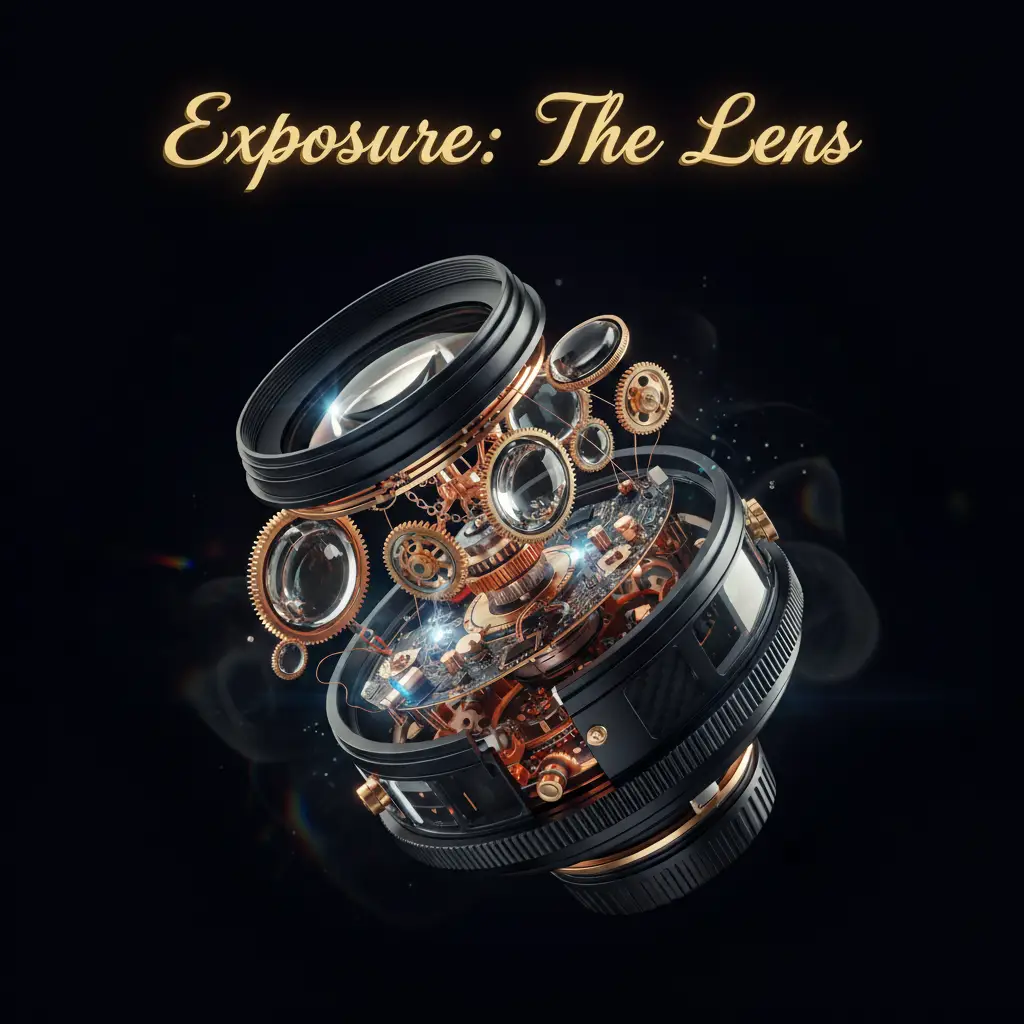
Welcome to this short lesson about one of the most important (if not the most important) element of photography: the lens. Many beginners focus on the camera body, but the truth is that the lens is what "draws" the image. It is the eye of your camera. Let's see why.
1. Introduction: Why Do We Need Lenses?
- In the early days of photography, there was the "camera obscura" (dark chamber). This was basically a box with a very small hole.
- Light entered through that hole and projected an upside-down image on the opposite wall. The problem? The image was very dark and blurry.
- People realized that to get a bright and clear image, they needed a larger hole, but a large hole cannot focus light.
- This is where physics intervened: a curved piece of glass (a lens) can gather a large amount of light and concentrate (focus) it into a single point.
- Lenses emerged from this need: to gather as much light as possible and focus it precisely on a sensitive material (film or, today, the digital sensor).
2. What Exactly is a Lens?
In short, the lens is a tube containing a set of glass lenses. Think of it as your camera's glasses. Its role is to capture the light rays reflected from the scene in front of you and "bend" them to form a perfect and clear replica of that scene, right on the sensor surface.
3. Basic Structure: What's Inside a Lens?
- Optical Elements (Lenses): The heart of the lens. There are several, arranged in "groups", to correct optical defects and allow functions like zoom.
- Diaphragm (or Aperture): A set of metal blades that form a hole that can be enlarged or reduced to control how much light enters the camera.
- Focus Mechanism: Moves certain lenses to make the subject appear sharp. It can be automatic (Autofocus) or manual.
- Mount: The metal piece at the back, which attaches to the camera body.
4. What Are They Made Of?
- Lenses: Made of high-purity optical glass, coated with special anti-reflective layers (coatings) to reduce reflections and improve contrast.
- Body: Cheap lenses are made of plastic, while professional ones use metal alloys and are often sealed against dust and moisture.
5. Classification and Categories of Lenses
The most important characteristic is the focal length (measured in millimeters, "mm"), which tells you how "zoomed in" (tele) or "wide" (wide) the image is.
- Prime Lenses: Have a single focal length (e.g., 50mm). You cannot zoom.
- Zoom Lenses: Have a range of focal lengths (e.g., 17-70mm). You can turn a ring to zoom in or out.
6. In Short: Prime vs. Zoom - Which is Better?
Neither. They are different tools for different purposes.
ZOOM Lenses (17-70mm or 10-20mm):
- ✅ Major Advantage: Versatility. They are perfect for travel, events, or landscapes (like in your autumn photo), allowing quick reframing without moving.
- ❌ Disadvantage: Usually, they are "darker" (aperture is smaller, e.g., f/2.8-f/5.6) and involve a slight compromise in optical quality.
PRIME Lenses (50mm or 105mm):
- ✅ Major Advantage: Quality and Light. They have very wide apertures (e.g., f/1.8). This means two things:
- Excellent performance in low light (like in the soldier photo).
- Beautifully blurred background ("bokeh"), which isolates the subject (perfectly visible in the dog portrait).
- ❌ Disadvantage: Lack of versatility. You are stuck at one focal length. You have to "zoom with your feet".
7. Characteristics of Each Category (with Examples)
A. Wide-Angle Lenses (e.g., 10mm - 35mm)
- What they do: Capture a lot of the scene.
- Perfect for: Expansive landscapes, architecture, small spaces.
- Example (10-20mm Lens): The adjacent images (the mountain landscape, the foggy village, and the urban plaza) show how a wide lens can capture an extremely broad field of view, conveying a sense of space.
B. Standard Lenses (e.g., 40mm - 60mm)
- What they do: Offer a perspective similar to the human eye. The 50mm is the most famous.
- Perfect for: Portraits, street photography, travel.
- Example (105mm Macro Lens): These images (the bee, dandelion, and moth) show the power of macro. The lens allowed focusing very closely to capture incredible details, impossible to get with a normal lens.
C. Standard Zoom Lenses (e.g., 17-70mm)
- What they do: They are the "all-rounder" lenses, extremely versatile.
- Perfect for: Travel, events, everyday photography.
- Example (17-70mm Lens): These images show versatility. The lens can be used at its wide end (like the autumn landscape) or its tele end (to compress the winter forest or capture the sunset station)
D. Telephoto Lenses (e.g., 70mm - 300mm+)
- What they do: Bring distant subjects "close" and compress the perspective.
- Perfect for: Portraits (85mm, 135mm), sports, and wildlife (200mm+).
E. Macro Lenses
- What they do: They are special lenses that can focus extremely close.
- Perfect for: Insects, flowers, textures, jewelry.
- Example (105mm Macro Lens): The butterfly image shows the power of macro. It allowed focusing very closely to capture incredible details, impossible to get with a normal lens.
8. Decoding the Lens: What Do the Letters and Numbers Mean?
Let's take an imaginary example: "Nikon AF-S NIKKOR 50mm 1:1.8G" or "Canon EF 70-200mm f/2.8L IS USM". It looks complicated, but it's simple:
- Nikon / Canon / Sony / Sigma / Tamron: This is the manufacturer.
- AF-S / USM / HSM: Indicates the type of autofocus motor (AF-S and USM are fast and quiet).
- 50mm: This is the focal length. Being a single number, it's a Prime Lens.
- 70-200mm: This is the focal length range. Being two numbers, it's a Zoom Lens.
- 1:1.8G or f/1.8: This is the most important number after the focal length. It represents the maximum aperture. A small number (like 1.8) means a large (wide) aperture, which lets in a lot of light.
- f/2.8: On a zoom, if you see a single aperture number, it means the lens can maintain that wide f/2.8 aperture throughout the entire zoom range (from 70mm to 200mm). These are the expensive, "pro" lenses.
- f/3.5-5.6: This is called a variable aperture. It means that at the wide end (e.g., 18mm) the max aperture is f/3.5, but as you zoom in (e.g., to 55mm), the aperture automatically closes down to f/5.6. These are the cheaper, kit lenses.
- L / G / Art: Letters indicating the series or quality. "L" on Canon, "G" or "N" on Nikon, "Art" on Sigma indicate the top, professional series.
- IS / VR / OSS / OS: Indicates Image Stabilization. "IS" on Canon, "VR" on Nikon, "OSS" on Sony. This feature helps reduce hand shake, allowing for sharp photos at longer shutter speeds.
9. A Special Category: Vintage (Manual) Lenses
It's important to note that besides modern autofocus lenses (described by "AF-S", "USM", etc.), there is a whole world of vintage (manual) lenses.
- Exclusively Manual Focus: As the name suggests, they do not have an autofocus motor. Sharpness (focus) must be set manually by turning the focus ring.
Why are they popular?
- Many photographers seek them out for:
- Unique Character: They often have optical "imperfections" (like distinct flare or unique bokeh) that provide an artistic look, hard to replicate digitally.
- Build Quality: Many are made entirely of metal and glass, making them extremely robust.
- Price: They can be an affordable way to experiment with bright prime focal lengths (e.g., an old 50mm f/1.4).
- Adaptability: With a simple adapter, most of these old lenses can be mounted and used on modern cameras, especially mirrorless ones.
10. Maintenance Tips
- Use Caps: Always put the caps on when the lens is not on the camera.
- Use a Protection (UV) Filter: It acts as a shield for the front lens element. It's cheaper to replace a filter than the lens.
- Proper Cleaning: First, use an air blower for dust, then a clean microfiber cloth for fingerprints. DO NOT use your t-shirt!
- Beware of Humidity: Do not store them in damp places. Humidity can lead to fungus growth inside.
11. Common Problems That Occur
- Internal Dust: Unavoidable in zoom lenses. A few specks of dust won't show up in photos.
- Fungus: The most serious problem. Looks like a fine spider's web inside and degrades the image. It's caused by humidity.
- Scratches: A scratch on the front lens rarely affects the image. One on the rear lens is much more serious.
- Faulty Autofocus: The focus motor can break, especially if the lens is dropped.
12. Final Message: Invest in Glass
A famous saying in photography goes: "Buy a camera body you can afford, and a lens you can't afford." Camera bodies change every 2-3 years. Good lenses (quality glass), whether modern autofocus or vintage manual, retain their value and performance for decades. They are what truly define the style and quality of your photographs.
Test