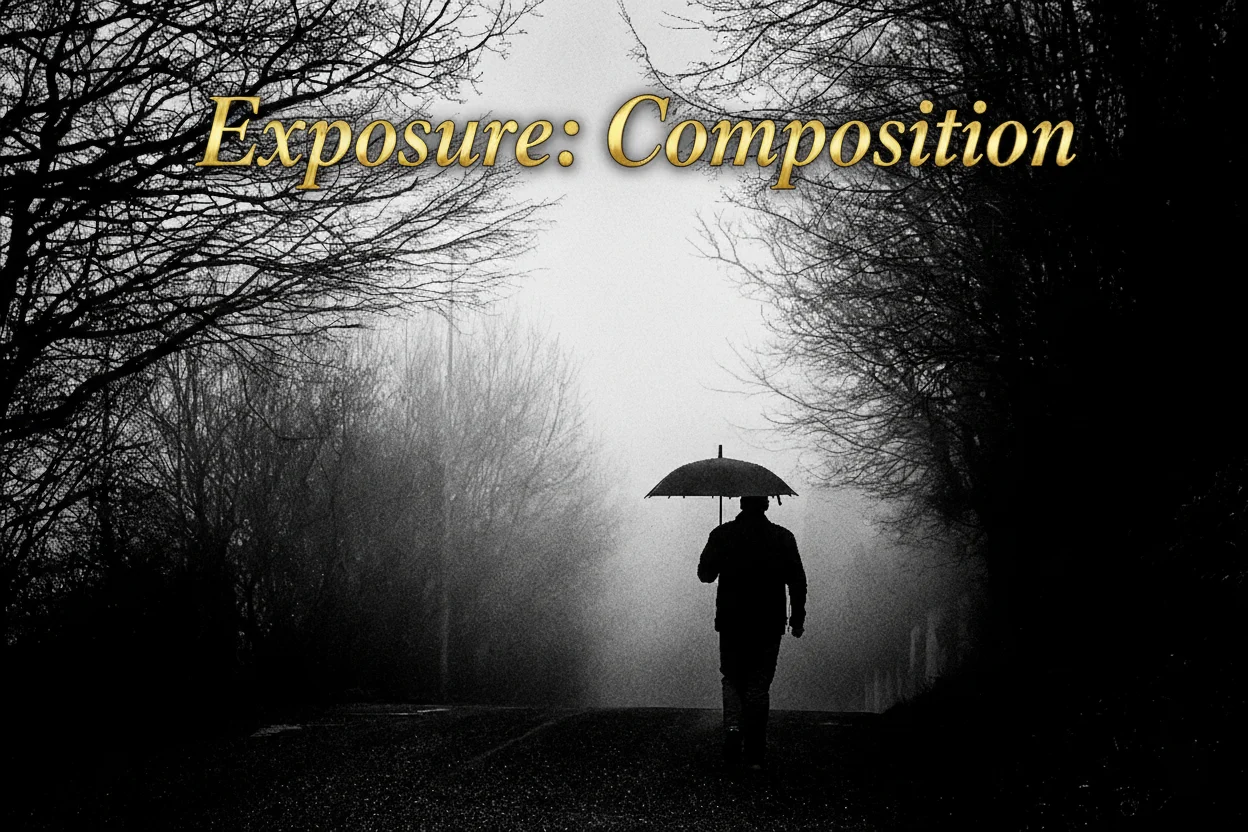
A complete lesson on the art of arranging visual elements within the frame. From basic rules to advanced concepts, learn how to guide the viewer's eye and create impactful images.
1. What Is Composition and Why Is It Important?
What Is Composition?
Composition (from Latin compositio, 'to put together') is how you arrange the visual elements (lines, shapes, colors, light, and shadows) within your frame. In short, it is the intentional organization of your image.
Where Does It Come From and Why Is It Important?
- Origin: Composition rules weren't invented by photographers. They were used and perfected by painters, architects, and sculptors for thousands of years (starting from Ancient Greece, the Renaissance, etc.). Photography simply adopted them.
- Purpose (Importance):
- Guiding the Eye: Good composition guides the viewer exactly where you want them to look. It creates a 'visual path' that leads to the main subject.
- Conveying Emotion: A symmetrical frame conveys calm and stability, while an asymmetrical frame can convey tension or dynamism.
- Creating Order from Chaos: The real world is chaotic. A well-composed image transforms this chaos into a pleasant structure that is easy for the human brain to decode.
2. Types of Composition (The Basic Rules)
These rules are the pillars of composition and apply to any photographic genre:
A. The Rule of Thirds
- How it works: The image is mentally (or on the camera screen) divided into nine equal parts by two horizontal and two vertical lines.
- Application: Important subjects should be placed either on these lines or at their intersections (Points of Interest).
- Why it works: Placing the subject in the center is static and boring. The rule of thirds creates visual tension and allows the eye to explore the rest of the scene.
B. Leading Lines
- What they are: Any line in the image (paths, roads, rivers, fences, shadows) that draws the viewer's eye from the foreground towards the main subject in the distance.
- Application: Use lines that start from a corner of the frame and lead deep into the image.
C. Symmetry and Patterns
- Symmetry: Using elements that mirror each other. Choose it when you want to convey stability, calm, or grandeur.
- Patterns: The repetition of shapes, colors, or textures. Repetition creates harmony, and breaking the pattern immediately draws attention (e.t., a red flower in a field of white flowers).
D. Negative Space
- What it is: The empty, often uniform space (sky, water, a simple wall) that surrounds the subject.
- Application: It allows the main subject (Positive Space) to occupy a small part of the frame.
- Why it works: It emphasizes the subject and gives the eye room to breathe. It can create a feeling of isolation or minimization.
E. Natural Framing
- What it is: Using elements from the scene (an archway, a window, a tree branch) to surround and draw attention to the main subject.
- Application: It adds depth and context, giving the viewer the feeling of peering into a frame within the frame.
3. Planes and Depth (Foreground, Mid-ground, Background)
A strong composition creates the illusion of depth (three-dimensionality) on a flat surface (the photograph) by dividing the scene into planes:
- Foreground: The element closest to the camera. Compositional Role: Adds depth, texture, and creates a leading line.
- Mid-ground: This is usually where the Main Subject is. Compositional Role: It is the area of maximum interest and sharpness (focus).
- Background: Everything behind the subject. Compositional Role: Adds context (landscape, details), or can be blurred (Bokeh) to isolate the subject.
4. Viewpoint (Where You Stand)
The viewpoint (or point of view) refers to where you physically place the camera and, consequently, the angle from which you shoot:
- Eye Level: The most common and natural.
- Low Angle: Makes the subject appear taller, powerful, or dominant.
- High Angle: Makes the subject appear smaller, vulnerable, or insignificant.
5. Advanced Elements for Maximum Impact
These techniques take composition to the next level, controlling movement and emotion in the frame:
A. Rule of Space
- What it is: When your subject is moving or looking in a direction, you should leave more free space in front of them (in the direction of action or gaze) and not behind them.
- Impact: It gives the viewer a sense of anticipation and keeps the subject's movement within the frame, maintaining dynamism.
B. Implied Triangles
- What it is: Using three key visual elements in the frame to mentally create a triangle (even if not connected by physical lines).
- Impact: The triangle is the most stable geometric shape. Using them provides stability, visual balance, and is excellent for group portraits.
C. Aspect Ratio
- What it is: The ratio of the image's width to its height (e.g., 3:2, 4:3, 16:9, 1:1).
- Compositional Impact: The choice of aspect ratio dictates how you compose:
- 1:1 (Square): Very stable, excellent for symmetry and minimalist compositions.
- 3:2 (Standard DSLR): More dynamic and versatile, good for action.
- 16:9 (Cinematic): Very wide, ideal for panoramic landscapes.
D. Color and Texture (Emotional Impact)
- Color: Warm Colors (Red, Yellow) create energy and intimacy; Cool Colors (Blue, Green) convey calm and distance.
- Texture: Gives the viewer a tactile sensation. Placing a rich texture (bark, sand) in the foreground adds depth and realism.
6. Composition Types by Photo Genre
The ideal composition differs depending on what you are shooting:
Portrait
Ideal Composition: Rule of Thirds on the eye. Rule of Space (in the direction of the gaze). Shallow depth of field (bokeh) for isolation. Avoid: Cropping at joints (neck, knees, ankles). Busy backgrounds.
Landscape
Ideal Composition: Strong Leading Lines. Include an interesting Foreground for depth. Horizon placed on one of the horizontal thirds. Avoid: Horizon placed exactly in the middle. An empty foreground.
Macro
Ideal Composition: Fill the Frame. Total isolation via bokeh to highlight details. Avoid: Backgrounds that compete with the small subject. Focusing on anything but the most important point.
Architecture
Ideal Composition: Perfect symmetry and straight vertical lines. Natural frames (a door, a window). Avoid: Vertical lines that appear to be falling (due to angle).
Street Photography
Ideal Composition: The Decisive Moment. Framing with urban elements. Depth (passersby in foreground, action in mid-ground). Avoid: Slow composition. You must be fast.
7. When to Break the Composition Rules
Rules are excellent for learning, but they are not absolute laws. An advanced photographer knows when to break them for a specific effect.
- 1. When Symmetry is King (Ignore Rule of Thirds): If your subject is a perfectly symmetrical bridge or an ideal reflection in water, placing it exactly in the center is the strongest decision. Central symmetry conveys stability and strength.
- 2. When You Want Tension or Confusion: If you want to convey chaos, discomfort, or strong kinetic energy, you can use strong oblique lines, place the subject too close to the edge, or ignore negative space (filling the frame).
- 3. When the Subject Is Very Large or Very Small: If you are shooting a macro detail (a butterfly's eye) or a minimalist landscape (a single tree), Filling the Frame or Extreme Negative Space can be more powerful than the rule of thirds.
Golden Tip:
Learn the rules like a professional, so you can break them like an artist.
Be the first to leave a comment!,